The QAEHS HDR Student Best Publication Awards (for papers published in 2025) were awarded on Monday 7th September.

The HDR Student Best Publication Awards are maintained by annual funding from QAEHS to encourage and reward HDR students who are the primary authors of high-quality publications. The 1st place winner received $1,000, with three Commendation winners received $500 each.
1st Place was awarded to Marina Suzuki for her Environmental Science & Technology paper, Number of carbons is a critical parameter for accumulation of per- and polyfluoroalkyl substances in the human brain. Marina commented that “this publication award means a great deal to us, and I am incredibly grateful that the hard work we put into this research have been recognised in such a positive way. I would also like to sincerely thank all of my co-authors for their invaluable contributions. Receiving this award has given me even more motivation to pursue exciting research and generate meaningful findings that can contribute to advancing scientific knowledge.”
Commendation awards were presented to:
- Dr Jinglong Li for his paper Occurrence, removal and risk assessment of antimicrobials and their transformation products in effluent from Australian wastewater treatment plants published in Environmental Science & Technology.
- Tobias Hulleman for his paper Machine learning for predicting environmental mobility based on retention behaviour published in Environmental Science & Technology.
- Dhaya Nadarajan for her paper Wastewater analysis as a global toxicovigilance tool for the monitoring of new psychoactive substances published in Water Research.
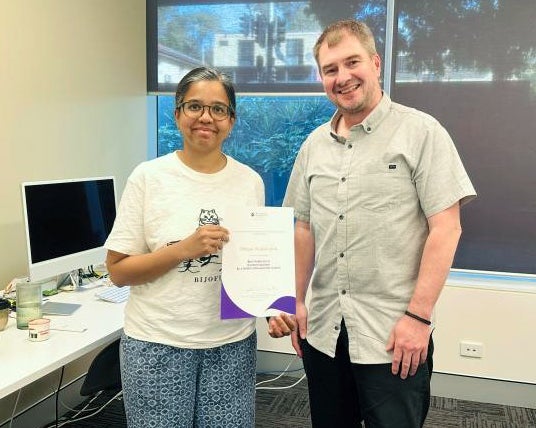
Dhaya stated “I was surprised by the announcement, as this award is highly competitive and many QAEHS students apply each year. It took me a very long time to complete this work. I must thank Dr Richard Bade for being patient with me, encouraging my unstoppable flow of ideas, and giving me this opportunity. I am very happy that I was able to contribute to the New psychoactive substances (NPS) Wastewater Consortium’s work, particularly through the quality assurance of cartridges shipped to Australia and the evaluation of controlled substances from a legislative perspective.”
Dr Li, who completed his PhD with QAEHS when this paper was published, said “I am honoured to receive this award and grateful for the support of my colleagues and collaborators. This recognition motivates me to continue my research in environmental health and contribute to protecting both human health and the environment.”