
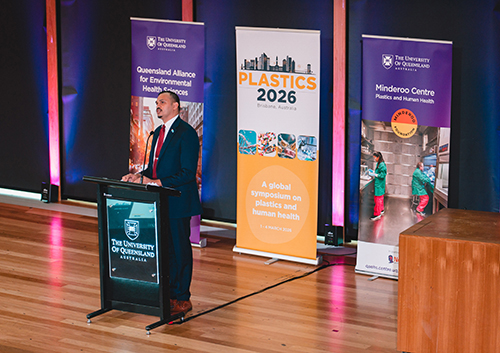
QAEHS hosted in the inaugural Plastics2026 conference in early March. The conference brought together scientists, medical professionals, industry leaders, and policymakers to address the urgent need to understand the risks associated with plastics in the environment as well as devising strategies to mitigate negative health impacts.
The conference, held over 4 days, was attended by over 230 delegates from across the world with presentations covering research in key areas including analytics, exposure, inventory, regulation and policy, risk and epidemiology and toxicology.
The opening afternoon of the conference, Sunday 1st of March, was held at The University of Queensland’s Advanced Engineering Building’s GHD Auditorium. Proceedings commenced with an official welcome from Professor Deborah Terry AC, Vice‑Chancellor of The University of Queensland as well as opening remarks from both the United Nations Under‑Secretary-General and UNEP Executive Director Ms Inger Andersen and Dr Andrew Forrest AO, Co-Founder of the Minderoo Foundation.
The main conference program, Monday 2nd March to Wednesday 4th March, was held at W Brisbane with delegates enjoying keynote and oral presentations from over 75 presenters as well as conference poster presentations from over 95 delegates.
The program showcased nine keynote sessions from leading international experts. Dr Andrea Hinwood (United Nations Environment Programme) presented a concise overview of plastic pollution across its life cycle, linking production, environmental emissions, and regulation to broader planetary health impacts. The presentation focused on global policy responses, highlighting progress and challenges associated with the proposed Global Plastics Treaty and the importance of translating scientific evidence into coordinated international action.
This was followed by a joint keynote from Emeritus Professor Sarah Dunlop (Minderoo Foundation) and Philip Landrigan (Lancet Countdown on Health and Plastics) exploring emerging evidence on the effects of plastics on human health.
The final keynote of the day was delivered by Dr Sivendra Michael (Fiji’s Ministry of Environment and Climate Change), who highlighted geographical inequalities in pollution exposure and access to environmental research, noting that communities most affected are often under‑represented in scientific evidence. It emphasised the need to address plastic pollution and its health impacts from a global perspective through more inclusive and representative research approaches.
The keynote presentation by Professor Martin Wagner (Norwegian University of Science and Technology (NTNU)) reframed plastic pollution as a challenge of chemical complexity rather than solely a materials issue, highlighting the thousands of plastic‑associated compounds that remain poorly characterised. The presentation outlined current research on plastic additives and their real‑world environmental and health implications, underscoring the challenges these chemicals pose for effective monitoring and risk management and the importance of robust scientific evidence to inform solutions to plastic pollution.
QAEHS’s Dr Cassandra Rauert reviewed the current state of research into detecting micro‑ and nanoplastics in human tissues, noting that while analytical methods are advancing, challenges such as sample interference and detection limits remain significant. The presentation highlighted how these limitations can introduce uncertainty or misleading results, reinforcing the need for continued methodological improvement and critical evaluation in this emerging field.
Professor Da Chen (Jinan University) presented extensive high‑quality data across multiple classes of plastic additives, highlighting the importance of robust evidence for advancing research in this field. It offered detailed insights into the environmental distribution and health risks of emerging additives, with particular emphasis on polymeric additives, including brominated polymeric additives. The keynote demonstrated how comprehensive datasets can strengthen understanding of plastic‑related chemical risks and support improved assessment and management strategies.
Associate Professor Phoebe Stapleton (Rutgers University) set the scene for toxicology by outlining current models used to assess chemical health risks, focusing on links between environmental exposure, internal and biologically effective doses, and disease outcomes. It also showcased the speaker’s research on generational health effects of microplastic inhalation, highlighting emerging evidence of impacts across life stages.
Dr Shoji Nakayama’s (National Institute for Environmental Studies) presentation outlined findings from a national cohort study of mother–infant chemical exposures across regions, showing how lifestyle factors shape exposure over time. Drawing on Japan’s large‑scale longitudinal research from pregnancy through childhood, Dr Nakayama highlighted the value of long‑term, nationally coordinated cohort studies for understanding exposure trajectories, health risks, and informing risk assessment and policy across the life course.
While Dr Jane Muncke (Food Packaging Forum Foundation) explored chemicals in plastic food packaging and the potential health risks of exposure to complex mixtures. It outlined possible risk‑reduction pathways while questioning the adequacy of current assessment methods, emphasising the need for more comprehensive approaches to evaluate and manage mixture exposures associated with food packaging.
QAEHS Attendance
QAEHS had a large cohort of researchers and PhD students attend the conference with many providing research updates via oral, flash or poster presentations. QAEHS researcher, Dr Cassandra Rauert, was also one of the keynote speakers, delivering an address on the Analytical challenges with human biomonitoring of micro/nanoplastics: Bombshell or progression of science?.
Other QAEHS presentations included:
- Dr Fisher Wang on Addressing low-concentration BPA quantification challenges in urine samples using a native analyte addition method
- Laura Puente on Assessment of infant oral exposure to micro and nanoplastics from plastic feeding and storage containers
- Dr Ken Tang on Migration of plastic and adhesive-related oligomers (PAROs) from puree pouches: a comparison between food simulants and food samples
- Marina Suzuki on Per- and Polyfluoroalkyl Substances in the Human Brain
- Honglin Chen on Understanding spatial and temporal trends of atmospheric microplastics and nanoplastics in laboratories
- Lily Pan on Assessing the permeation of surface-modified nanoplastics (NPs) across in vitro human gut-blood and blood-brain barrier models
- Dr Grace Davis on Defining Unequivocal: Increasing Confidence in the Analysis and Reporting of Micro- and Nanoplastic Particles in Biological Matrices
- Danielle Que on Nonylphenol exposure in an Australian population using urinary biomarker analysis, Insights on short-term urinary variability and exposure sources of bisphenols and phthalates through Questionnaire- and Urine-based Exposure Source Tracking (QUEST)
- Nathan Charlton on Dialling Down the Heat: Assessing Nanoplastic Standard Recoveries in a Simulated Oxidative Digestion Protocol
- Haitao Lin on Hyphenated analytical workflows for Characterising nanoplastics exposure from drinking water
- Ruvini Weerasinghe on Developing methods for detecting novel halogenated microplastics for informing future risk assessment
- Ian Zammit on Validation of a method for identification and quantification of bisphenols and phthalate metabolites in post-mortem human brain
- Elvis Okoffo on Plastic in our water: what Australians may be drinking
- Julia Orr on Serum PFAS concentrations in the Australian population: Comparison between data from the National Health Measure Survey (NHMS) and pooled deidentified serum from a pathology laboratory
- Marta Lopez on Evaluating the Blood–Brain Barrier Permeability of Organophosphate Flame Retardants (OPFRs) Using an In Vitro Model